Sculptra Training
Are you interested in learning more about the cosmetic injectable Sculptra Aesthetic? You’ve come to the right place. National Laser Institute’s Sculptra training course is tailored to fit all of your educational needs and will instill the confidence you need to succeed as a cosmetic injector.
This course is specifically designed for Registered Nurses (RN), Physicians’ Assistants (PA), Nurse Practitioners (NP), and other medical professionals looking to add this in-demand biostimulator to their practice. A cosmetic injector is a medical professional certified and trained to administer cosmetic injectables — including dermal fillers, Botox, and Sculptra — and responsible for assessing each patient’s needs to achieve their desired result. The course combines didactic and hands-on learning styles to provide students with the knowledge and skills necessary to deliver the best possible patient outcomes.

What Is Sculptra?
Unlike traditional dermal fillers, which add immediate volume, Sculptra is a biostimulator: it’s a Poly-L-lactic acid (PLLA), a synthetic, biodegradable form of lactic acid produced naturally within the body, that works by stimulating the body’s own collagen production over time to gradually restore lost volume and create a fuller, softer, more contoured appearance. Sculptra comes prepared as a freeze-dried preparation in a glass vial, made up of polylactic-L-lactic acid, sodium carboxymethylcellulose, and non-pyrogenic mannitol.
The Aging Process Sculptra Addresses
Aging is a biological process in which the body’s baseline cell proliferation diminishes, and we lose approximately 1% of our collagen every year. A combination of muscle and fat atrophy, weakening fascia, bone reabsorption, and reduced collagen, elastin, and fibrin levels all work together to create an aged appearance — visible as shrinking cheek volume, weakened lip volume, flat spots in the midface, deepening nasolabial folds, a sinking mentalis crease, marionette lines, and jowls. A youthful face, by contrast, shows full, prominent cheeks, smooth facial transitions, and a firm jawline. Because Sculptra works as a biostimulator, it’s often used in conjunction with neuromodulators like Botox and traditional dermal fillers for a more comprehensive result.
Reconstitution And Dosing
Sculptra is reconstituted using bacteriostatic water (not bacteriostatic saline, which is reserved for Botox) — typically 5 to 8mL, shaken vigorously by hand for about a minute until the solution appears as a white, translucent suspension free of lumps. It can be used immediately or stored at room temperature for up to 72 hours. Lidocaine can be added for patient comfort, typically 1mL of a 1% solution added just before the procedure.
The most common dosing for facial correction is two vials per treatment, injected bilaterally, though treatments can range up to four vials for the face or as many as ten for larger areas like the derriere. Most patients need one to four treatment sessions to achieve their desired outcome, depending on the severity of volume loss — and because results build gradually, it’s important to set expectations with patients that changes will unfold over several weeks rather than appearing immediately.
Patient Assessment And Contraindications
Before treatment, a cosmetic injector should conduct an in-depth evaluation of the patient’s volume deficits and physical features. Considerations and contraindications include multiple drug allergies, pregnancy or breastfeeding, facial implants, any active skin infection or upper respiratory infection, compromised immunity, sensitivity to any ingredients, and a history of more than one anaphylactic reaction.
Sculptra Injection Technique
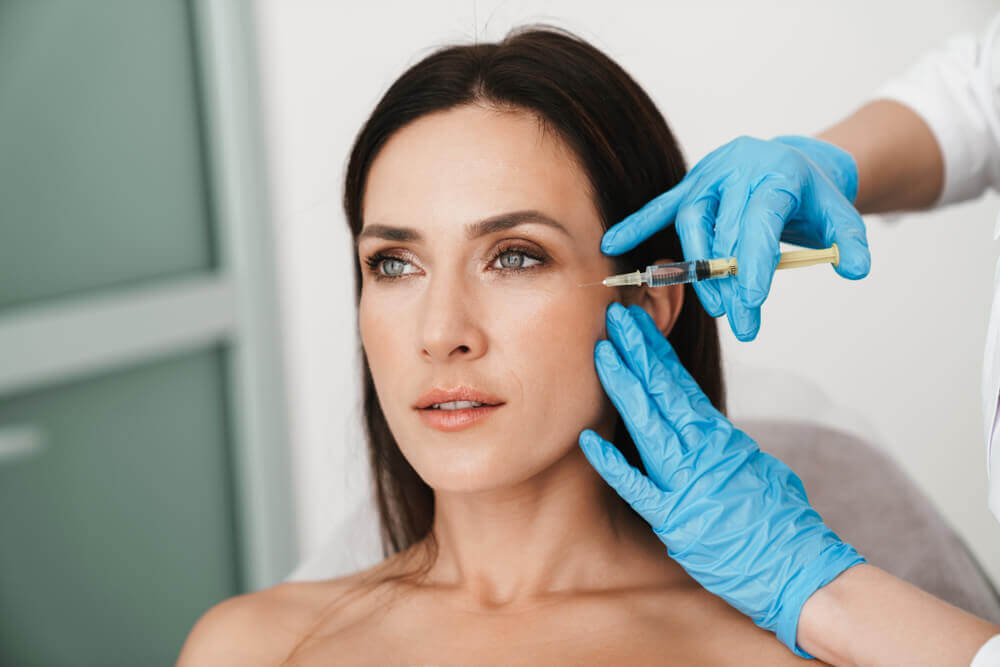 Prior to treatment, markings are made to outline the areas to be injected. Several techniques can be used, including linear threads, parallel threads, fanning, and cross-hatching — fanning is the most common, since it covers the treatment area with the fewest injection sites. Sculptra is typically drawn up in 3mL, 5mL, or 10mL syringes and injected using 26G or 25G straight needles; because of Sculptra’s large particle size, thin-walled needles are recommended to reduce clogging.
Sculptra is injected into the subcutaneous or supraperiosteal plane using a tunneling or threading technique, with a slow retrograde push to deposit product evenly. Aspiration before injection is essential to help prevent complications like vascular occlusion. Injectors are trained to limit fluid to half a vial per treatment area, and to massage treated areas in a circular motion during the procedure to ensure even distribution.
Possible Side Effects
Because Sculptra adds volume through injected fluid, some post-procedure swelling is expected — a single two-vial treatment can involve injecting as much as 18mL of fluid into the facial area. More serious but rare side effects can include hives, difficulty breathing, angioedema, and dizziness, along with small lumps beneath the skin, fever, or sore throat. One delayed side effect to watch for is the development of subcutaneous papules and nodules at the injection site, which can typically be minimized by avoiding overly shallow injection depth.
Two-Day Sculptra Training Course Structure
National Laser Institute’s course is split into two segments, the first half is digital pre-study and the second half is spent training hands-on.
The Didactic Portion Includes:
- Studying the history of Sculptra Aesthetic cosmetic injectables.
- Learning safety measures needed when utilizing Sculptra Aesthetic.
- Understanding cannula usage using Sculptra Aesthetic injectables.
- Learning and understanding how and why Sculptra Aesthetic PLLA, poly-lactic-acid, works for increasing collagen stimulation.
- Understanding how and why Sculptra Aesthetic works as a biostimulator.
- Understanding the aging process and why a biostimulator works in conjunction with neuromodulators and dermal fillers.
- Discovering safety in use and injection of Sculptra Aesthetic cosmetic injectables.
- Learning how to use cannulas for facial treatment injections.
- Choosing the proper patient for Sculptra Aesthetic cosmetic injectables.
- Understanding the consultation process for proper patient selection.
- Learning the risks and benefits of the use of Sculptra Aesthetic injectables.
Hands-On Clinical Training
Hands-on clinical training follows each didactic session, giving students one-on-one guidance from an experienced instructor while practicing the consultation process and injection technique on real, scheduled clients, which is a far more valuable experience than practicing solely on fellow students. By the second day, students move into extended hands-on clinical time, working directly with clients under supervision to build genuine confidence and competence.
Additional Materials And Tools
Upon enrollment, you’ll receive a digital course manual including history, consent and policy forms. Upon course completion, you will earn a certificate of training along with CE or CME credits.
Frequently Asked Questions
How is Sculptra different from traditional dermal fillers?
Traditional hyaluronic acid fillers add immediate volume that the body eventually breaks down. Sculptra works differently — it stimulates your own collagen production gradually over several weeks, which means results build subtly over time rather than appearing all at once, but also tend to last considerably longer.
How many vials does a typical patient need?
Most facial treatments use two vials per session, injected bilaterally, though the total across a full treatment plan depends on the severity of volume loss and can range from one to four sessions.
Is Sculptra painful?
Lidocaine is commonly added to the reconstituted solution to minimize discomfort during injection, and most patients tolerate the procedure well.
Why Choose National Laser Institute For Sculptra Training?
At National Laser Institute, courses are led by top experts in the field, with extensive experience in medical aesthetics. Our instructors will equip you with the knowledge and skills to effectively incorporate Sculptra Aesthetic into your practice, backed by real hands-on experience with scheduled clients rather than mannequins or classmates.
Why wait? Contact us today to start your journey into cosmetic injectables with Sculptra training, or call 800-982-6817.

About the Author
Louis J. Silberman is the CEO and Co-Founder of National Laser Institute, the pioneer of the medical aesthetics training industry and the largest educator in the country. NLI also operates one of the busiest medical spas in the country, seeing up to 3,000 clients per month. Louis Silberman is also an entrepreneur who has been named Ernest and Young’s EY Entrepreneur of the Year Semifinalist.